

An AI-powered financial clarity layer built to help everyday users understand where their money goes and feel genuinely in control without adding more work to their day.
My Role: Lead Product Designer
Product Type: FinTech
Team Members: Laura, Jisoo, Jennifer
01 OVERVIEW
What is this project?
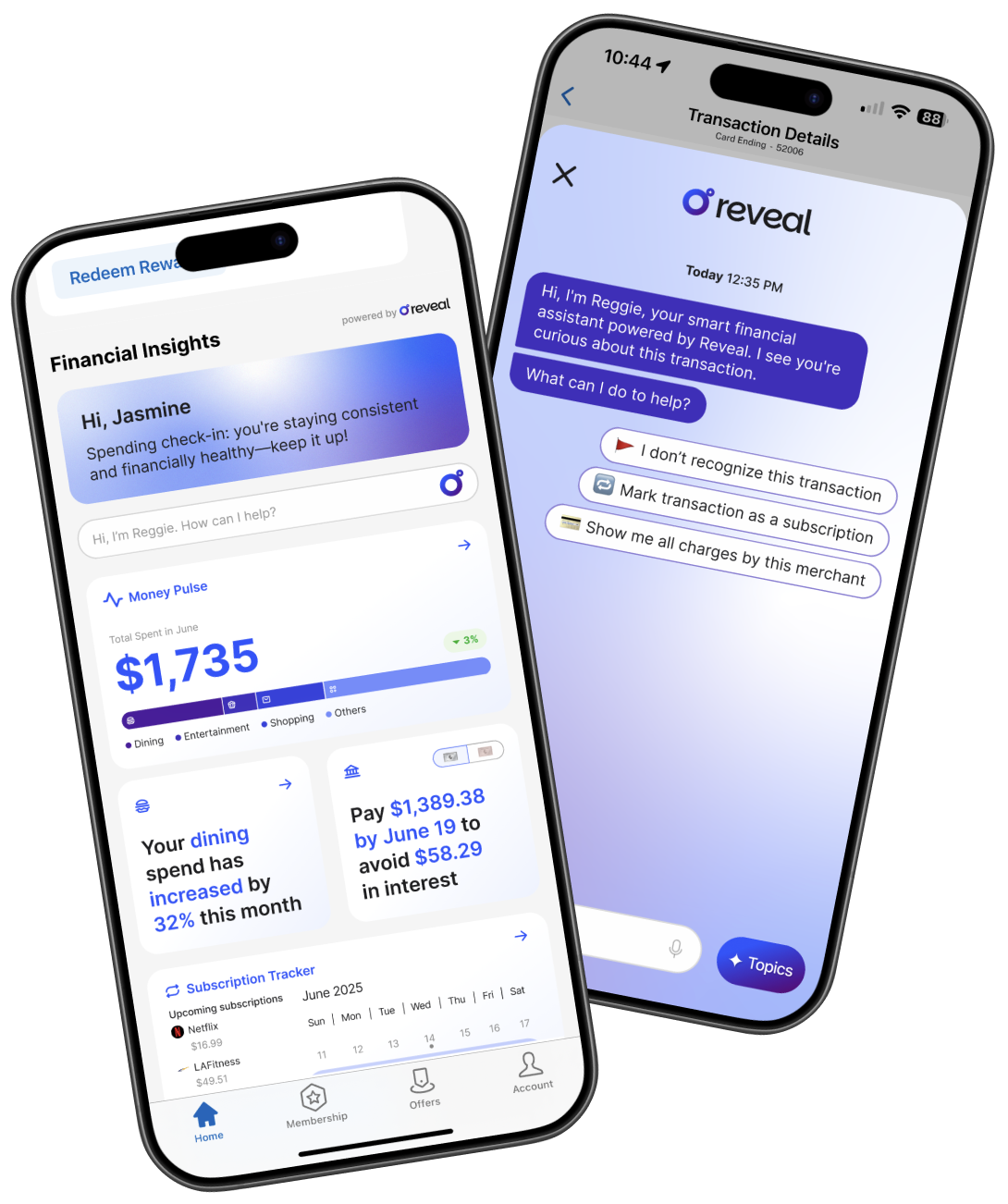
Reveal is an AI-powered financial wellness experience designed to help users better understand, track, and take control of their spending habits.
Built as a B2B plugin for the AMEX app, the project focuses on reducing financial stress by transforming complex transaction data into clear, actionable insights.
Through in-depth user research, Reveal uncovered how users often rely on mental math, avoid checking statements, and struggle with unclear transaction details.
The solution introduces intelligent spending summaries, proactive money pulse notifications, gamified saving challenges, and an AI assistant that helps users make more confident financial decisions.
"The problem isn't your spending. It's the lack of visibility." The insight that shaped every design decision in this project.
My Role
I served as the Lead Product Designer on a team of four, overseeing project timelines, sprint planning, stakeholder communication, task prioritization, and cross-functional coordination throughout the project lifecycle.
Alongside managing key product and project management responsibilities, I led the end-to-end design process conducting user research, defining user flows, creating wireframes, designing high-fidelity UI screens, and ensuring design consistency across multiple features and touch points.
02 PROBLEM
What problem are we solving?
Through initial interviews with 9 participants and a detailed competitive analysis, we discovered that users weren’t just struggling with spending, they were struggling with understanding their financial activity clearly and confidently. Many relied on memory, invoices, notifications, or external apps to verify transactions, recognize charges, and track expenses effectively.
💵
Users lack a clear, organized view of their spending, making it hard to track monthly expenses, identify patterns, and stay in control of their credit usage.
💳
Users struggle to quickly identify and verify unfamiliar charges, often relying on manual investigation through transactions, receipts, and notifications to confirm legitimacy.
🧾
Users struggle with unclear and inconsistent transaction details, making it difficult to recognize purchases, verify charges, and confidently track their spending.
Top 3 insights from interviews
🔍
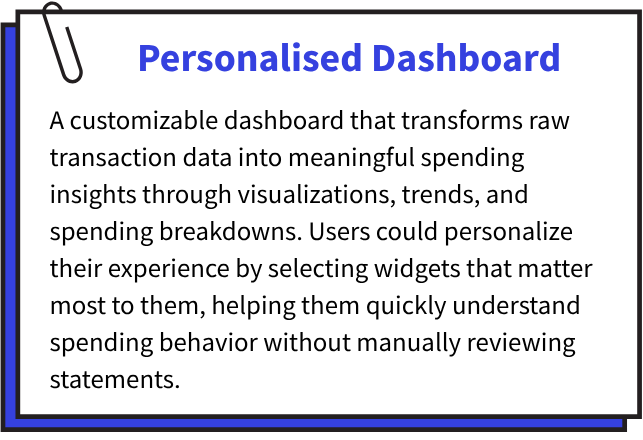
Users struggle to recognize purchases because merchant names are inconsistent and transaction details often lack clarity, making unfamiliar charges difficult to verify quickly.
📊
Most tools offer only basic spending summaries, with limited categorization, personalization, or clear monthly breakdowns, making it harder for users to understand spending patterns.
⚠️
Many financial platforms rely on manual tracking and provide limited proactive alerts, automation, or smart financial guidance, leaving users to monitor spending and subscriptions themselves.
Insights from Competitive Analysis
Problem Statement
Users struggle to understand and trust their monthly credit card bills because transaction information is unclear, difficult to verify, and lacks meaningful context. This makes tracking spending, identifying charges, and managing finances feel confusing, manual, and overwhelming.
Business Goals
1. Increase Customer Retention & Engagement 📈
By helping users better understand and manage their finances within the banking app, the solution reduces reliance on third-party tools and creates a more trusted, high-value customer experience.
2. Drive Revenue Through Increased Product Usage 💳
Improved financial visibility and personalized insights encourage users to engage more frequently with their credit cards and explore additional banking products and services.
3. Improve Operational Efficiency & Trust ⚙️
Proactive transaction insights, clearer billing information, and fraud-related support can reduce customer service inquiries while strengthening trust through a secure, in-app financial experience.
03 USERS
Who are the users?
Reveal is designed for credit card users who actively manage their finances but struggle to clearly understand, track, and verify their monthly spending.
Primary Users
Young professionals in their mid-20s to early 30s
Frequent credit card users managing multiple transactions and subscriptions
Users who regularly check statements but feel overwhelmed by unclear transaction details
Digitally savvy users who prefer mobile-first financial experiences
Users looking for more control, transparency, and personalization in managing their spending



04 DESIGN PROCESS
How did I approach this?
Step 1 - Understanding User Pain Points
To understand how users manage their credit card bills, I conducted interviews with 9 participants and synthesized findings through affinity mapping. The research revealed a common challenge: users struggled to understand, verify, and confidently manage their financial activity due to unclear transaction details, unfamiliar charges, and limited visibility into spending patterns.
To validate these findings, I also conducted a competitive analysis of platforms including Chase, AMEX, Apple Wallet, Monarch, Rocket Money, and Copilot to identify industry gaps and opportunities.
Step 2 - Define Problem
After synthesizing research and competitive insights, we identified a core issue around financial clarity and trust. While users had access to their financial data, they struggled to understand, verify, and act on it confidently. Unclear transaction details and limited context made tracking spending and managing finances feel manual and overwhelming.
Problem Statement:
Users struggle to understand and trust their monthly credit card bills because transaction information is unclear, difficult to verify, and lacks meaningful context.
Step 3 - Map the features
With the problem clearly defined, we explored multiple concepts that could help users better understand, organize, and manage their monthly credit card activity. Guided by user needs and competitive gaps, our ideation focused on increasing financial transparency, improving transaction clarity, and giving users greater control over how they view and interact with their spending data.
We identified three key opportunity areas:
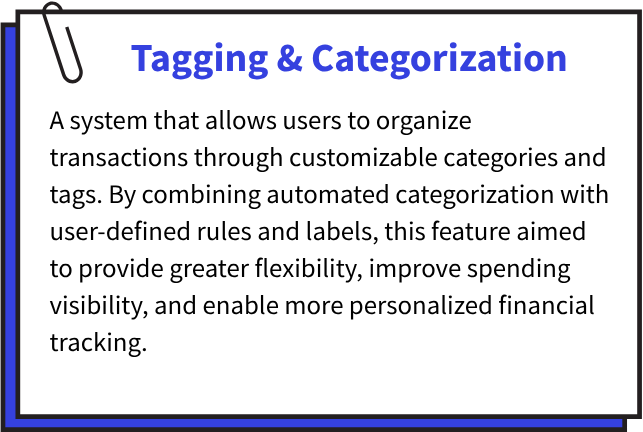
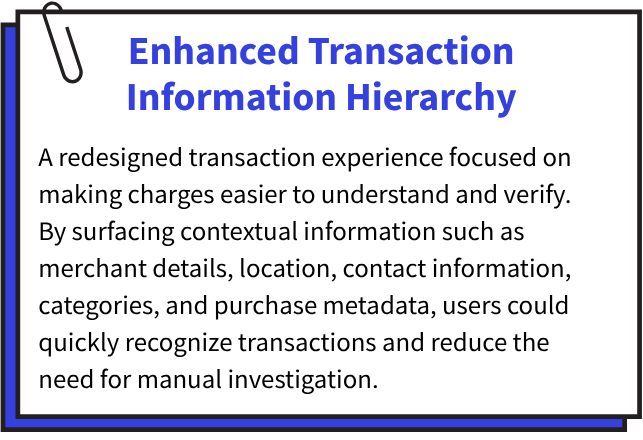
Together, these concepts addressed the three major pain points uncovered during research: Unclear transaction visibility, limited spending transparency, and the lack of proactive financial support.

— 04 — DESIGN
From user flows to a system that feels calm
Our wireframe process moved through three fidelity levels — rough sketches, mid-fi flows, high-fi prototype. At each stage we tested with users and adjusted. The most significant pivots came from watching where people hesitated.

Primary user journey from landing to financial clarity.
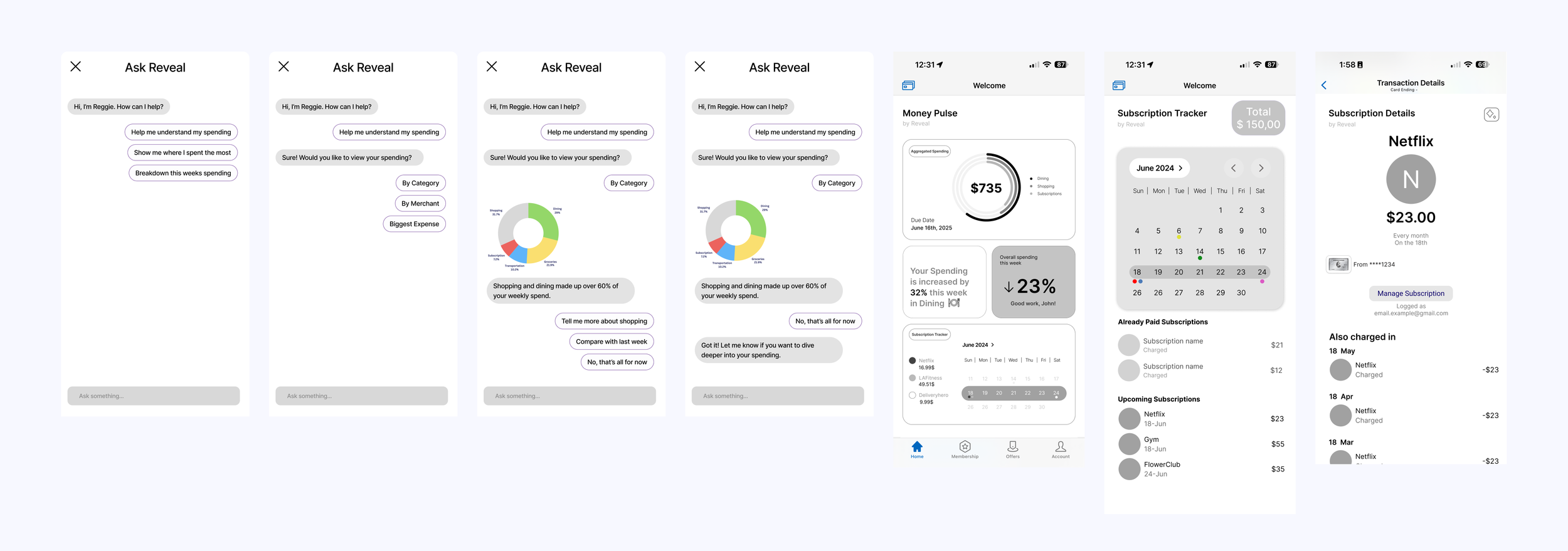
Mid-Fidelity Wireframes showcasing insights dashboard, transaction detail, subscription manager, Reggie entry point.
Logos

Chat Bubbles


Buttons


Color Palette

Navigation Bar

Icons
Emojis


Health Tracker

Charts


Logos

Trend indicators

Design system for Reveal
THE SOLUTION
Bringing Clarity to Everyday Finances
Managing finances is tough with unpredictable spending and hidden subscriptions. This AI-powered solution with a subscription tracker helps users monitor spending, manage recurring payments, and get personalized recommendations for better financial control.


Meet Reggie, Reveal’s AI bot helping user understand transaction details and more…
Financial Insight with multiple widgets giving detailed information into user spending
Detailed insights to understand spending spikes and easy dispute of transactions
— 05 — USABILTY TESTING
The chatbot placement that changed everything
We tested three flows with real users: exploring spending insights, managing subscriptions, and interacting with Reggie. The feedback reshaped all three — but the Reggie placement was the biggest learning of the entire project.


V1 — INSIGHT DASHBOARD
Charts were small and dense. Users struggled to understand what changed or why it mattered. Key metrics were buried. The primary view had too much competing for attention.
V1 — REGGIE (FAB)
Floating action button with a bot icon. 60% recognition. 40% had no idea what it did. Users weren't confused about AI, they were confused about context.
V1 — SUBSCRIPTION
The word "block" confused users. They couldn't tell the difference between blocking and cancelling. Post-blocking steps were unclear, creating hesitation and distrust.
V2 — INSIGHT DASHBOARD
Simplified to one key metric per module with a drill-down layer for detail. Added descriptive language ("Up 22% this month — mostly from dining") alongside the chart, not instead of it.
V2 — REGGIE (CONTEXTUAL)
Moved below transaction detail with a plain-language prompt. Near-universal recognition. No redesign needed, just the right moment, the right place.
V2 — SUBSCRIPTION
Replaced "block" with clear action language. Added an explanation of what happens post-action. Early communication of limitations boosted trust and completion rates.
FINAL DESIGN
Reveal — a human layer for credit card experiences
Reveal isn't just an insight engine. It's the layer that makes the complex feel calm — sitting inside the AMEX app, available exactly when users need it, invisible when they don't.
100%
Reggie recognition after contextual placement fix
3
Flows designed & tested end-to-end
V1 → V2
Full iteration driven entirely by test data

01
02
03
04
— 07 — FINAL DESIGN
Reflections
Emotional safety is a design constraint. When we tested a spending alert that said "Your dining spend jumped 40% this month," users felt judged — not informed. We rewrote every piece of data communication to be descriptive rather than evaluative. That shift from "you overspent" to "this is what changed" is what made the product feel supportive rather than punishing.
Co-leading taught me that product decisions are negotiation. Managing timelines, pushing back on scope creep, and keeping a four-person team aligned while each of us owned different flows — that stretched me beyond design craft. I learned to make tradeoff decisions with incomplete information and communicate them clearly.
Feature placement is half the design. Moving Reggie from a FAB to a contextual prompt below the transaction detail improved discoverability dramatically with zero visual redesign. Where a feature lives shapes whether users reach for it.
Systems thinking isn't optional in financial design. Every screen in Reveal exists in relationship to every other screen. Designing one widget without thinking about how a user got there — and where they'll go next — produced confusing flows in V1. Building a proper design system early would have saved us from inconsistencies we had to fix in iteration.
Next Project
Made with ❤️ and lots of iced lattes